Your lawn doesn’t always tell you what’s wrong, but it usually gives you clues. During a summer service visit, our technicians aren’t just looking at whether your grass is green. They’re looking for the signs that tell us why your lawn looks the way it does.
A thorough lawn inspection can reveal problems before they become larger issues. In Houston, where lawns can face intense heat, unpredictable rainfall, irrigation challenges, insects, disease, and aggressive weeds, knowing what to look for matters.
At GreenGate Turf & Pest, our technicians evaluate the condition of the turf during service visits and pay attention to changes that could affect its health. Sometimes the issue is obvious, such as a large brown patch. Other times, the clues are much more subtle.
Here are six things our technicians check during lawn inspections.
1. Signs of Lawn Pests
One of the first things technicians look for is evidence of lawn pests.
Insects can cause significant turf damage, and their symptoms can sometimes look remarkably similar to heat stress or drought stress. A homeowner may see brown or thinning grass and assume the lawn simply needs more water. However, the underlying problem could be an insect infestation.
Chinch bugs are a good example. These small insects are particularly problematic in St. Augustine grass and can become an issue during hot weather. Chinch bug damage can produce areas of discolored or dying turf that may initially look like drought damage.
Sod webworms are another pest technicians watch for during the growing season. Their larvae feed on grass blades and can create thinning or damaged areas throughout the lawn.
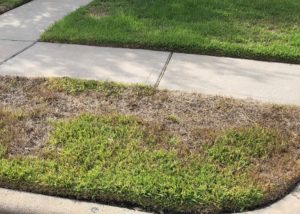
During a lawn inspection, technicians may look for:
- Discolored or dying patches of grass
- Thinning turf
- Chewed or damaged grass blades
- Areas where turf is declining unexpectedly
- Signs of insect activity
- Patterns of damage that could indicate a pest problem
The important thing is that technicians don’t simply see brown grass and assume they know the cause. The location, pattern, condition of the surrounding turf, and other clues can help determine what may be happening.
2. Signs of Lawn Fungus or Disease
Summer can create conditions that encourage certain lawn diseases. Warm temperatures, moisture, humidity, poor airflow, and other environmental factors can all contribute to turf problems.
That’s why lawn fungus and disease are another important part of a lawn inspection.
Disease doesn’t always appear as a dramatic, easily identifiable patch. Early symptoms can include subtle discoloration, thinning, unusual patterns, or areas of turf that don’t seem to be growing normally.
Technicians look at the overall appearance of the grass and compare questionable areas with healthier portions of the lawn.
They may look for:
- Brown or discolored patches
- Thinning turf
- Unusual patterns in the grass
- Areas that repeatedly struggle
- Changes in grass color or density
- Symptoms consistent with common turf diseases
This distinction is important because not every brown spot has the same cause. Insects, disease, watering problems, heat, drought, soil conditions, and other environmental factors can all affect turf.
For example, Houston lawns can experience disease issues such as large patch or take-all root rot. Identifying potential problems early gives homeowners a better opportunity to address the conditions contributing to declining turf.
3. Watering and Irrigation Issues
Even the best lawn care program can’t compensate for a lawn that isn’t receiving water evenly.
That’s why irrigation is another major part of what technicians observe during a lawn inspection.
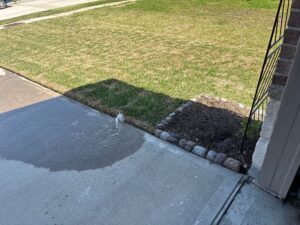
A lawn may appear healthy in one area while showing stress in another. When that happens, inconsistent sprinkler coverage
may be part of the problem.
Technicians pay attention to areas that appear unusually dry, especially when the rest of the lawn is doing well. They may also notice areas that consistently seem too wet.
Signs that can point toward watering or irrigation issues include:
- Dry patches
- Uneven turf color
- Grass that is consistently stressed in one area
- Areas that stay excessively wet
- Poor sprinkler coverage
- Turf declining near specific irrigation zones
Too little water can contribute to drought stress, but more water isn’t necessarily the answer. Overwatering can create its own set of problems and may contribute to conditions that encourage certain diseases and other turf issues.
That’s why understanding the pattern of the problem is so important.
A technician may notice that one section of the lawn repeatedly struggles while another section remains healthy. That observation can provide a clue that something beyond the turf itself needs attention.
4. Lawn Weed Pressure
Weeds are another thing technicians keep an eye on during lawn inspections.
Summer lawn weeds can take advantage of thin or stressed turf. When grass isn’t growing densely, there can be more opportunities for unwanted plants to establish themselves.
Some weeds may be easy to spot, while others can blend into the lawn until they’ve become more established.
During a service visit, technicians look for changes in weed pressure and identify what types of lawn weeds may be appearing.
They may notice:
- New weeds appearing in the turf
- Increasing weed pressure
- Weeds concentrated in thin areas
- Weeds along lawn edges
- Weeds appearing in stressed portions of the yard
- Changes from previous visits
This ongoing observation is useful because weed pressure can change throughout the year. Different weeds emerge under different environmental conditions, and weather can influence how quickly they develop.
A lawn inspection isn’t simply about identifying what’s wrong today. It’s also about noticing changes over time.
When technicians regularly visit a property, they become familiar with how that lawn normally looks. That makes it easier to recognize when something has changed.
5. Overall Turf Health and Summer Stress
Sometimes there isn’t one obvious problem. Instead, the lawn is simply showing signs that it’s under stress.
Summer lawn care is particularly important in Houston because turf has to deal with high temperatures, intense sunlight, periods of limited rainfall, and other environmental pressures.
Technicians look at the overall condition of the turf, including its:
- Color
- Density
- Growth
- Uniformity
- Response to environmental conditions
- General appearance
They also watch for signs of heat stress, drought stress, compaction, and other issues that can affect turf health.
A lawn doesn’t have to be completely brown to be stressed. Changes in color, density, or growth can be early indications that the grass isn’t performing as well as it normally does.
This is where having a trained professional look at the lawn can be helpful. Instead of focusing on a single symptom, technicians can consider the bigger picture.
For example, if a lawn is thinning in several areas, the cause might not be immediately obvious. Is it getting enough sunlight? Is the soil compacted? Is there heavy foot traffic? Is irrigation reaching the area? Is there insect or disease pressure?
Those are the types of questions a technician considers during a lawn inspection.
6. Areas That Need Extra Attention
Not every part of a lawn behaves the same way.
Some areas naturally experience more challenges than others, so technicians pay special attention to places that consistently struggle.
These may include shaded areas, slopes, high-traffic zones, areas near pavement, locations with drainage problems, and spots where turf repeatedly becomes thin or discolored.
For example, grass growing next to a driveway or sidewalk may experience additional heat because surrounding hard surfaces absorb and radiate heat. A shaded section may have different growing conditions than an area receiving full sunlight.
Likewise, a slope may have different water distribution than a flat portion of the property. Areas with poor drainage may remain wet longer, while other sections may dry out quickly.
These environmental differences can provide valuable clues.
Technicians look at the lawn as a whole while also paying attention to these individual trouble spots. Recurring problems are especially worth noting because they may indicate an underlying condition rather than a one-time issue.
Why Regular Lawn Inspections Matter
A lawn inspection is more than a quick glance at the grass.
Your lawn is constantly responding to its environment. Weather changes, pest activity, disease pressure, irrigation, mowing, traffic, soil conditions, sunlight, and seasonal changes can all influence turf health.
A problem that starts small may become much more noticeable if it isn’t identified and addressed.
Regular inspections allow technicians to watch for changes over time. That’s particularly valuable when the same technician or lawn care team becomes familiar with the property.
Instead of asking only, “Does this lawn look green?” technicians can ask more useful questions:
Is the turf becoming thinner?
Are there new areas of discoloration?
Has weed pressure increased?
Are there signs of lawn pests?
Does the pattern look like heat or drought stress?
Could irrigation be contributing to the problem?
Is a particular area consistently struggling?
Those observations help create a clearer picture of what’s happening in the lawn.
Your Lawn Is Always Giving You Clues
Healthy turf doesn’t happen by accident. It takes the right combination of nutrients, water, mowing practices, environmental conditions, and ongoing monitoring.
And sometimes, the most important part of lawn care is recognizing a problem before it becomes obvious.
That’s why our technicians don’t just focus on whether your lawn looks green when they arrive. They’re looking for the details behind that appearance.
Lawn pests, lawn fungus, lawn weeds, irrigation problems, heat stress, drought stress, and difficult growing conditions can all leave clues. The more consistently those clues are monitored, the easier it can be to understand what your lawn needs.
Keep Your Houston Lawn Looking Its Best
If your lawn is showing brown patches, thinning grass, unusual discoloration, increased weeds, or other signs of stress, don’t wait for the problem to get worse.
GreenGate Turf & Pest provides professional lawn care services designed to help Houston-area homeowners maintain healthier, better-looking turf throughout the year. Our technicians inspect your lawn during service visits and look for the signs that can help identify potential problems.
Contact GreenGate Turf & Pest today to learn more about our lawn care services and schedule service for your property.