

If you’ve noticed small moths flying low over your lawn, especially around dusk, you may be wondering whether you have a pest problem. With so many different moth species in Texas, it’s easy to assume that every moth around your grass is bad news.
Fortunately, that’s not the case.
Some lawn moths are simply passing through. Others are the adult stage of caterpillars that can feed on turfgrass. And some, like the beautiful luna moth, have absolutely no interest in turning your lawn into an all-you-can-eat buffet.
Then, of course, there’s Mothman.
We’ll get to him.
For Houston-area homeowners, understanding the difference between harmless moths and lawn pests can help you determine when your grass actually needs attention. Let’s take a closer look at some of the lawn moths and moth-related pests you may encounter in Texas, including tropical sod webworms, fall armyworms, luna moths, and one particularly suspicious cryptid.
What Are Lawn Moths?
“Lawn moths” isn’t the scientific name for one particular species. Instead, it’s a general term people often use for moths they notice flying around or living near their lawns.
Several moth species are associated with grasses and turf. Some belong to the family Crambidae, which includes many of the moths commonly associated with sod webworms.
Adult lawn moths are generally small and can be easy to overlook. You may see them fluttering just above the grass, particularly in the evening, before they quickly disappear into the turf or nearby vegetation.
But here’s the important part: the adult moth usually isn’t the insect causing damage to your grass.
In many cases, the problem is the caterpillar. The green worms in lawn.
After adult moths mate and lay eggs, the resulting larvae can feed on plants. Depending on the species, those larvae may feed on grass, trees, shrubs, or other plants.
That’s why seeing lawn moths doesn’t automatically mean you need pest control.
The presence of moths is simply one piece of the puzzle.
Tropical Sod Webworm: A Lawn Moth to Watch
One of the more important lawn-related insects to know about is the tropical sod webworm.
Tropical sod webworms are associated with warm-season turf, making them particularly relevant to homeowners in areas such as Houston and other parts of Texas.
As with other sod webworms, the larval stage is responsible for feeding on turfgrass. The caterpillars can hide during the day and become more active at night, making them surprisingly difficult to spot.
Meanwhile, the adult moths may be visible flying over the lawn.
That can create a frustrating situation for homeowners: you see moths, but you don’t necessarily see the insects actually eating your grass.
Sod webworm larvae are known to hide around the soil surface during the day and feed on grass at night.
If you’ve noticed an increase in lawn moths along with thinning or damaged turf, it’s worth taking a closer look at what’s happening in the grass.
However, don’t assume every moth means you have tropical sod webworms.
Identification matters.
What Does Sod Webworm Damage Look Like?
Sod webworm damage can sometimes be mistaken for other lawn problems.
You may notice small areas of grass that appear thin, brown or ragged. Damage may start out relatively minor before becoming more noticeable.
Potential signs include:
- Small brown or thinning areas
- Grass blades that look chewed or ragged
- Turf that appears increasingly thin
- Small moths flying low over the lawn
- Caterpillars hiding near the base of the grass
- Damage that becomes more noticeable over time
Sod webworm damage is generally more noticeable when the insects are active and the turf is already under environmental stress.
But there is an important catch.
Brown grass doesn’t automatically mean sod webworms.
Houston lawns can develop brown patches because of drought, irrigation problems, fungal diseases, chinch bugs, soil conditions, heat stress, and other factors.
That’s why diagnosing the problem before treating it is so important.
Grass Moths and Veneer Moths: What’s the Connection?
Another reason lawn moths can be confusing is that several different types of moths can be associated with grasses.
You may hear terms such as grass moth, lawn moth, sod webworm moth, or veneer moth used when discussing these insects.
However, these terms don’t necessarily refer to one specific species.
Veneer moths are a broader group of moths, and not every veneer moth is a sod webworm moth. At the same time, the adult moths associated with sod webworms are part of the larger group of moths that homeowners may encounter around turf.
So if you see a small moth flying across your lawn, don’t immediately assume you’ve identified the pest.
The adult moth alone may not tell you enough.
The type of caterpillar, where it is found, and the type of damage occurring in the lawn can provide much more useful information.
In other words, don’t let one tiny moth convince you that your entire yard is under attack.
Fall Armyworm: The Caterpillar Behind the Moth
Fall armyworms are another major lawn pest that Texas homeowners should recognize.
The name can be a little misleading because the fall armyworm isn’t actually a worm. It’s the caterpillar, or larval stage, of a moth.
And unlike many moths that are harmless to turf, fall armyworm caterpillars can cause significant damage when populations become established.
Texas A&M AgriLife Extension identifies fall armyworms as major pests of permanent and improved pastures in much of Texas. They are generally most abundant from mid-summer into early November.
The adult fall armyworm is a moth that is active primarily at night.
Adult females can lay large numbers of eggs, which means populations can increase quickly when weather and environmental conditions are favorable.
The caterpillars are the ones homeowners need to worry about.
Fall armyworm larvae can range in color from greenish to brown or nearly black. Mature larvae can reach approximately 1 to 1½ inches long and often have a distinctive light-colored inverted “Y” marking on the head.
They can consume a surprising amount of grass in a short period.
That’s why regularly checking your lawn during periods of increased fall armyworm activity can be worthwhile.
Lawn Moths vs. Webworms: What’s the Difference?
The term “webworm” can make things even more confusing.
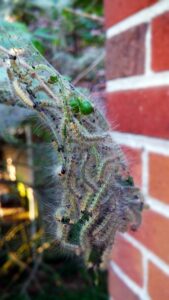
Webworm is a general term used for several types of caterpillars, and not every webworm is a sod webworm.
For example, fall webworms are known for creating large, noticeable silk webs in trees. Fall webworms commonly occur on deciduous trees and feed on leaves within their webs.
That’s very different from a sod webworm living in turf.
If someone says, “I found webworms in my yard,” the next question should be: Where?
Are they in the grass?
Are they in a tree?
Are they surrounded by silk?
What do the caterpillars look like?
Those details can help determine what you’re actually dealing with.
What About Luna Moths?
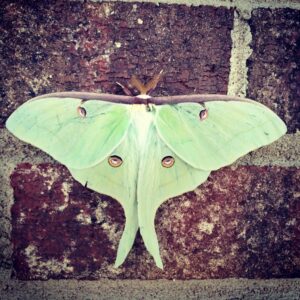
Not every moth deserves a pest-control technician.
Take the luna moth, for example.
Luna moths are among the most spectacular moths found in Texas. Their large, pale green wings, long tails, and prominent eyespots make them difficult to mistake for the tiny lawn moths commonly associated with turf.
Despite their size, luna moths aren’t something you need to worry about destroying your lawn.
Luna moth caterpillars feed on tree foliage rather than turfgrass. The adults don’t even
eat. Their adult lifespan is only about a week, during which their primary purpose is to reproduce.
So if you spot a luna moth resting on your house, fence, or porch, enjoy the sight.
Don’t call your lawn technician.
Call your neighbor over so they can see it too.
Why Are There So Many Moths in Texas?
Texas is a fantastic place for moths.
We have forests, prairies, wetlands, agricultural areas, gardens, trees, shrubs, and plenty of lawns.
Our warm climate also allows many insects to remain active for long stretches of the year.
That means homeowners will naturally encounter a wide variety of moths in Texas.
Some species are attracted to outdoor lights. Others are associated with particular plants. Some are active at night, while others are more likely to be noticed during the day.
And some are simply looking for a place to rest.
The important thing to remember is that seeing moths around your property doesn’t automatically indicate a pest infestation.
A few moths fluttering around your porch light aren’t necessarily a reason to reach for the pesticide.
Your lawn will tell you much more.
When Should You Be Concerned About Lawn Moths?
The presence of lawn moths becomes more noteworthy when you see them alongside actual turf damage.
Keep an eye out for:
- Increasing numbers of moths flying low over the lawn
- New brown or thinning patches
- Grass blades that appear chewed
- Caterpillars hiding near the base of the grass
- Damage that seems to spread or worsen quickly
- Turf that was previously healthy but is suddenly declining
If you see these signs together, you may have an insect problem that deserves closer inspection.
But again, identification comes first.
A lawn professional should consider the grass species, weather conditions, irrigation, symptoms, and insects present before determining the appropriate treatment.
That’s particularly important in Houston, where lawns can experience several different stresses at the same time.
A brown patch could be caused by an insect.
It could also be caused by water.
Or disease.
Or heat.
Or a combination of problems.
And Now, Mothman
We promised we’d get here.
Mothman.
Obviously, Mothman is not a real lawn pest.
At least, not one that we’ve officially confirmed.
We have no evidence that Mothman damages St. Augustine grass.
We haven’t found any scientific studies showing that he prefers Bermuda.
And we certainly haven’t seen him listed among the insects regulated by the Texas Department of Agriculture.
But if he ever shows up in Houston, we’re pretty sure he’ll be easy to identify.
He’s the six-foot-tall moth standing ominously at the edge of the lawn.
He’s the one staring directly at your technician without blinking.
And he’s probably the only pest that would respond to a service notification with, “You will regret this.”
Until science proves otherwise, we’ll classify Mothman as a cryptid rather than a lawn pest.
If you see him, however, we’d appreciate a photo.
Preferably from a safe distance.

How GreenGate Turf & Pest Approaches Lawn Pest Problems
At GreenGate Turf & Pest, we don’t believe every insect requires an automatic treatment.
Good lawn care starts with understanding what’s actually happening.
If you’re seeing lawn moths, tropical sod webworms, fall armyworms, or other insects around your property, the first step is identifying the pest and determining whether it is causing damage.
That means looking at the turf, inspecting for signs of feeding, considering environmental conditions, and identifying the insect whenever possible.
This matters because treating the wrong pest—or treating an insect that isn’t actually responsible for your lawn’s symptoms—can waste time and money.
For homeowners, the takeaway is simple:
Not every moth is a pest.
Not every webworm is a sod webworm.
And not every brown patch is caused by insects.
Final Thoughts on Lawn Moths
There are plenty of lawn moths in Texas, but they aren’t all bad news for your grass.
Some moths are harmless visitors. Others are connected to caterpillars that can feed on turf. Tropical sod webworms can become a concern in warm-season lawns, while fall armyworms can cause significant damage when populations increase.
Luna moths, meanwhile, are beautiful Texas insects that have no interest in destroying your lawn.
And Mothman?
Well, we’re keeping an eye on him.
The most important thing to remember is that identifying the moth is only part of diagnosing a lawn pest problem. The caterpillar, feeding damage, location, and condition of your turf all provide valuable clues.
So the next time you see a little moth fluttering over your grass at sunset, don’t panic.
It might be a pest.
It might be completely harmless.
It might be a tropical sod webworm moth.
Or, if it is approximately six feet tall and glowing red, it might be time to call someone.
Seeing Lawn Moths or Unexplained Damage in Your Houston Lawn?
If you’re noticing an unusual number of lawn moths, brown patches, thinning grass, or other unexplained turf damage, GreenGate Turf & Pest can help determine what’s happening.
Our team can inspect your lawn, identify potential pest issues, and recommend the appropriate course of action for your property.
Don’t wait for a small lawn pest problem to become a bigger turf problem. Contact GreenGate Turf & Pest today to learn more about our lawn care and pest control services.
And if you happen to see Mothman while you’re out there?
Take a picture.
We have questions.